

The System
Part 2 - The How?

Well this has taken rather longer to get to than I initially intentioned. As the title suggests, this is the second instalment to “The System - Part 1 - The What”.
I left off with the observation that I’d written a big old chunk of text outlining decisions and actions taken by the global system and that all of those cascade from the pinnacle, golden rule of keep the wealth flowing upwards.
But how the heck did we get to here, with a system dominating the planet universally to such devastating effect to ensure an obscene concentration of wealth and fairly liberal spreading of slaughter, theft and general all round depravity?
I’d like to discuss this question using one of the pre-eminent features of our system as the starting point - war, as I think everyone would agree that over the last number of centuries, it has been a fixed feature of society and the systems underpinning it. So it would appear to make sense to look at it and see where it might lead.
Could we define it as conflict in hyperdrive? Conflict exists in a myriad of expressions. War, by far, is the most horrific, destructive, unimaginable version of conflict ever witnessed. And what really seems to be the observation most overlooked is how needless it really is. In the sense that it is something created by us as a result of the societal structure we have thrust on top of the planet and ourselves - a set of laws and ideas and interactions manifested entirely by our collective thought processes, now and stretching quite far back in our history.
I think everyone would also agree that two features are universal to war. Lots of people die totally needlessly and in increasingly horrific ways , alongside which, a lot of money is made by a few - either directly or indirectly. Both features are true whoever allegedly wins the thing. So we could say they are defining characteristics. And of the two, we could agree that “making money” is, to a greater or lesser degree, a much more common motivating factor than simply ensuring people die in needless and horrific ways. Although, I’m sure that is also a reason shared by some. The nature of the societal structure, however, ensures nearly everyone has to deal with and think about money. And war is now waged to protect profit systems, right? So money is made while protecting the overall system of making money. You couldn’t make this shit up. Oh, hang on, yeah, collectively, we have.
We’d also (nearly) all agree that people dying is an unavoidable thread in the fabric of existence. Everything else does too, even the giant nuclear fusion power plants in space. The increasingly horrific and totally needless parts, however, they aren’t part of the fabric of existence. Those aspects are another thing bound and created by the societal system. Not by the universal energy that birthed the atomic soup we all swim in, in all its clear and present glory. No, I think it is clear that the entirety of that needless, horrific part is something we’ve unleashed (not the only thing we’ve unleashed). Let’s go with that for now, and see if it returns to our analysis.
This leaves us with people making money. Now, we can unequivocally say that money is an entirely man made construct. I think we could equally agree that money has been given virtually the same status in terms of its impact upon our very survival as things like air, water, food and shelter. Money is the entrance ticket for the societal construct, ensuring (allegedly) access to some of those essentials, such as food, water, shelter. I doubt it will be long, if we continue on the current trajectory, before we’re paying directly for air too.
Roll up, roll up! Get your entrance tickets here!
Could we look at this, at its very root, as an expression of the importance we have collectively given to the very concept of our thoughts? We’ve invented something as important as air, water, food, shelter and life itself! We stride the world like a colossus! All bend and bow and scrape before the God of Thought! Watch as death shoots from the omnipotent hands and pestilence infests in the almighty footprints! I AM THOUGHT, booms the voice.
We give such credence to thought that we are willing to slaughter millions to serve it.
So, is it just possible that there is something a little amiss in our relationship with our thoughts, both collectively and individually? And is that little something amiss the source of all of this chaos? At the very least it hardly seems a stretch to admit the possibility that something which spews out such misery may have something a little iffy within it?
I don’t know, but in the spirit of enquiry let’s see, shall we?
Let’s begin by agreeing what is irrefutable. Thought is important. But what is it?
Could we say in a very general, basic way that there is a stimulus, and then a sequence of results in the brain and mind that are a response to that stimulus, which is thought, and then resulting action if required? Basic example - Someone throws you the ball - stimulus - response in brain and mind and the action being catch.
There is also the element that thought becomes patterned in individual and collective behaviour - call it knowledge or habit if you will - Don’t eat the red berries! And the thought echoes into our shared experience. In this case with positive effect.
It’s also important to note that thoughts themselves become the stimuli - money again being the perfect example. It’s just an idea that we’ve collectively agreed has existed across millennia, making it part of our lived experience, bound up as one of the foundation blocks of our society. And we sure as shit spend much of our lives fretting over it, thinking about it, acting on those thoughts etc. To the extent now that as a collective we’ll wage or permit or acquiesce to war to protect it and ensure its flow in particular directions. Consciously, subconsciously, with some kind of show of resistance - whatever, the pattern remains evident and unbroken.
It is also plainly visible that ideas which remain purely as concepts can and do trigger subsequent thoughts and reactions. Take for example the idea of original sin. Your life is about becoming, not being. That there is a standard which you must strive to achieve to atone for being alive. Then you have a division - what actually happens in ones thoughts and actions versus some past notion that has been passed on as knowledge (to the young child) almost as if part of the fabric of existence, unchangeable. How could the child know otherwise? So the original sin idea becomes an image, in this case an idealised one, and present thoughts and actions are subject to comparison, approval etc to that past image. Which only exists within our thoughts. And this entire process gives rise to yet more thought and the process repeats and repeats and repeats. I think we could all agree that there is room for psychological division within that - perhaps some view it as natural, how we’re wired - this could be true. And that a pretty observable pattern of some kind of similar idea can be seen in the majority of cultures visible around the world at the moment. Make it if you try, honour something, reputation - they share that root. However, could we also agree that such a division, if true, is a form of psychological conflict? Not hyperdriven like a war, but a mini conflict nonetheless. I should be that, but what is happening now isn’t that. I’m a weak/bad/not what I planned etc person.
And if the conflict isn’t to do with the idiotic nature of that particular idea , but just an extreme example of a conflict which is part and parcel of this internal dynamic? A division of now versus the past knowledge of what it is to supposedly be human and how we interact and organise. Or what priorities there should be. Or what society is. All that mental baggage we collect on our journey through life. That’s an awful lot of internal comparison and division. Among which, undoubtedly, beauty manifests as well.
From this collection of thoughts we patch-work our identity. Our good old friend the ego - full of me, others, morals, rules, regulations, projections for the future, standards, promises to be happy and how that we just store through sheer repetition, or the pleasure we derived from their first instance, etc. So, in other words we use one collection of thoughts built throughout the past (the ego), to judge another set of thoughts happening in the present, which may indeed themselves be triggered as a result of the existence of the ego in the first place (think racism and resultant catholic guilt if you want an example). See how that splitting of thought into “I” the thinker and using it to perceive other thoughts could potentially be a division, a psychological chain reaction conflict throughout several thousand years in our heads. Billions of us now. One locust doesn’t make much sound, but 8 billion….?
Imagine a door that is only visible in outline and our ego opens it, walks in and finds itself in a maze. Beautiful, enticing, not obviously a maze at first and in it goes in the spirit of exploration. However, the maze is constructed by thought. And in trying to find our way out, using thought as the compass, we simply make the maze ever more complex, as the thoughts we apply as a solution simply construct new layers of the maze. So we think harder to find our way out and again the complexity increases and there is a loop that cannot be resolved, only broken.
What if this internal dynamic has simply rebounded like a jet-ball snowballing downhill across thousands of years? And as thoughts tend to do, observably manifested themselves in the real world and over millennia have become the impossibly complex societal system, including all its genocides and wars and rape and slavery and noncery?
The more we do it, the more we create division. What if I and my thoughts have become us and them. Haves and have nots. Slavers and Slaves. The oppressed and the oppressor? What if all these divisions and lines we have drawn in the form of nations, money etc are just expressions, repercussions of that imaginary internal division?
The loop, feeding back on itself across millennia, sadly, with ever more outward conflict and brutal expressions of it because now we’ve managed to enshrine that conflict based irrationality and its output into entities that do not die. They may rebrand, they may fade away and rebloom elsewhere, but as we agreed at the top, those that have made money have remained a consistent feature throughout our recent centuries long history of war. And sure, people make money. But the thing that makes the real money now is the corporate super-structure - the most rabid expression of division and hierarchy you can imagine. Again, nothing more than a thought structure manifested by our collective endeavours, yet so powerful it can write entire societal systems of interaction and organisation into our shared experience and carve them into the collective mind and protect them with a system of law and protect that with a system of governance and protect that with a system of media and protect that by co-opting culture and creativity and protect that by setting the agendas within the education system, think tanks, academia and just spewing out this conflict based thought code to be installed on the brand new baby hardware rolling off the assembly line and thus perpetuating this madness.
A thought system so deeply protected and enmeshed in all aspects of our existence that it has become the ultimate settler colonial. These patterns of thought force themselves on us whether we like them or not, there is no escaping them anymore, only seeing through them as best one can later. We accept this as our reality. And we struggle to cope, clearly.
So were does this leave us? Could it be there is no deciphering the settler colonial code? Deciphering indicates thought, thinking, working it out, a psychological then and now. A psychological future. A collection of thoughts now versus an alleged collection of them in the future. An attempted solution that simply invigorates and feeds the problem. Could the way out be different?
Is it simply when we face the potential of having made a wrong turn? It’s possible to do this on an academic level - I am proof - I can write this because I have read and heard conversations on this subject for many years. They have been stored, they form part of my collection of thoughts now. I use them to analyse my current thoughts and society in general. And so the cycle for me continues.
Is there a space beyond that, another way to relate to our thoughts? Other factors to balance out its importance, to guide it in their light, so to speak? There are those who claim this - foremost is probably Jiddhu Krishnamurti. Who spent much of his life talking about this, and in listening to him talk, whether one finds it interesting or not, it is plain to see and hear that there is something at least different going on, an analysis and philosophy quite unlike any other.
However, the only truth for me now is that I don’t know if there is any truth to any of the above.
I accept it is a possibility.
Yet here I think is the kicker - this is a truth that needs to be felt, not known.
Deep.
In the bones.
In the blood.
In the nervous system
In the heart.
Like a breath, if one puts attention on it.
Knowing implies intellect, thought. Feeling it, however, something much more primordial, much more resonant, from outside the sphere of thought. A vantage point that allows the conflict inherent in our thoughts to be experienced and in doing so calm the cacophony. Is there a transcendent light we can shine on them that reveals it to be the fallacy it potentially appears to be?
I’ve never felt it. I can’t feel it now.
I’m likely very afraid to feel it as I imagine it could appear to my ego and sense of self as some kind of death. Would my personality radically alter? Would I be so different that things I currently hold on to as important cease to seem so? Is it that the ego is so deeply connected to our sense of life, ourselves etc that it is utterly terrified to look and see the fairytale? Does it prefer to remain in the dark, cold and conflicted but in familiar surroundings, and crucially, still allegedly king of its own jungle ? Does it actually like the chaos underneath because it instinctively knows that as long as there is chaos there, its position at the peak of the psychological pyramid remains unthreatened? That is certainly a dynamic we can see in our society, right? - as discussed in Part 1.
Does cognitive dissonance occur between the ego and its sibling thoughts? We’re all aware these days that we often prefer the learned, engrained perception that already exists in our head versus the challenging, factual new information which contradicts it, with lots of studies and weight behind that. What is more present, more familiar to us than that voice, composed entirely of collected thoughts, in our head? What would be more alien to the ego than the idea that it is just a collection of thoughts, that the power, position and authority prescribed to it over other thoughts is just an illusion? If we resist crude, challenging information on observable stuff in the world like genocide…. then, how ferociously might we resist an observation that challenges the most familiar idea we all have? Replicate this across, in particular, modern westernish gung ho captialist cultures, would it appear a possible outcome that those societies would tend towards individualism, which would of course loop back and drive further individualism?
What often happens in such cases though is that the result of shifting to the new, more accurate perception is never as dramatic as we believed it would be before the event. Perhaps it will just be like a cold shower.
I remain open to the possibility that we’re individually and collectively clinging to our existing relationship with thought for reasons similar to the above. And that the moment when we see it for what it is is inevitable. I’m convinced that as a result this entire societal superstructure will collapse, as we’ll have deleted the settler colonial code from our head. Wide open, laying the fallacy of it all out in the light, where it will whither like mould in the sun.
Good luck running the manipulative, conflict based enrichment of the few system after that event.
And then get back to sailing through space together.
Which is what is actually happening as I type and as you read, and many thanks if you’ve got this far.
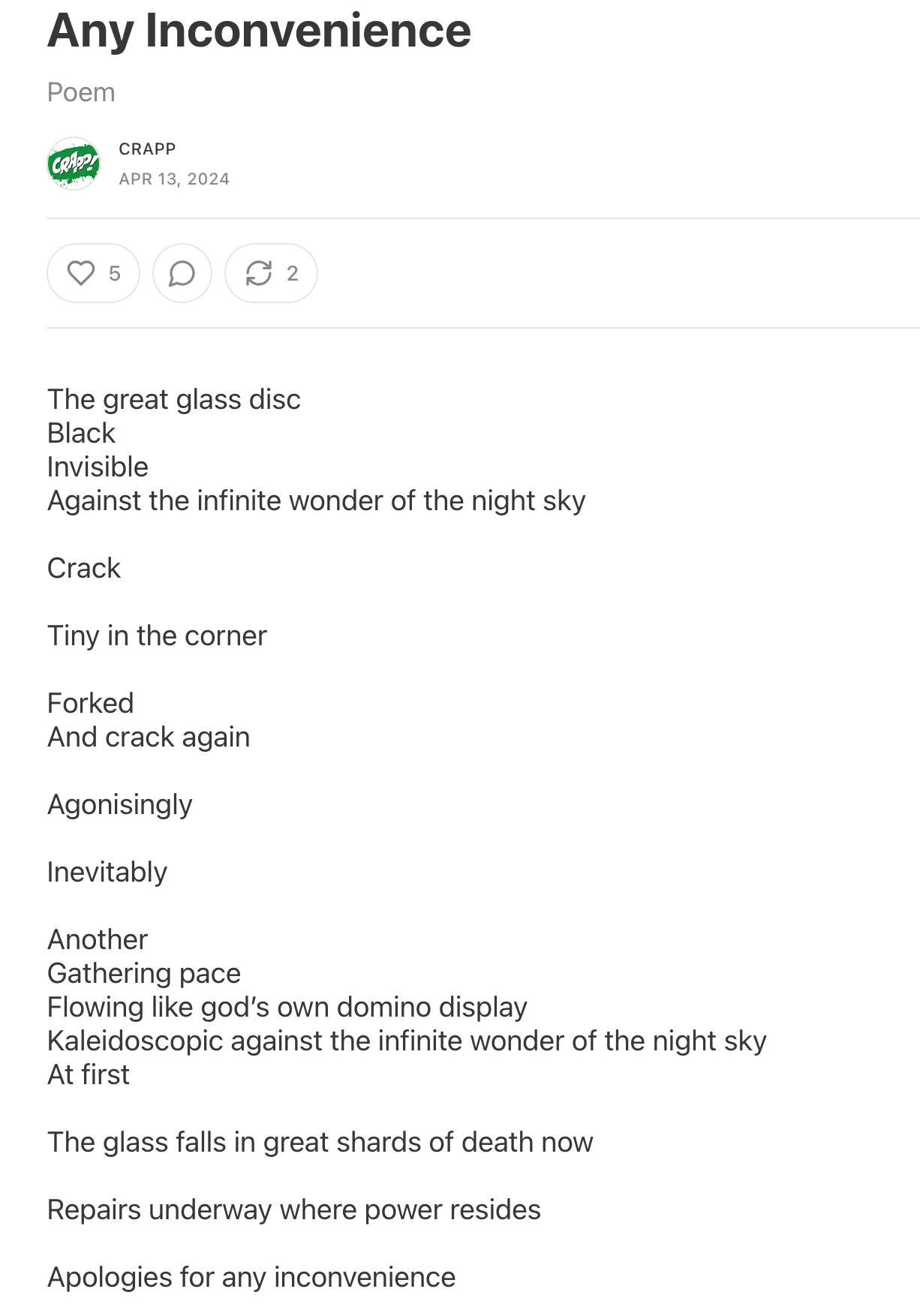
I’ll sign off with this short poem.
Wow. Seems like you’re attempting to explore/explain the vast whole of human interaction from an intimate starting point.
Allow me to offer some conversational feedback by way of historical analysis.
By way of anthropological study, our earliest, small scale societies were matriarchal: essentially egalitarian, peaceful, cooperative, loving and lacking in sexual anxiety.
The need for war was absent.
Here, men and women were considered ‘equal,’ with their relative gifts maintaining a general balance of power; I.e., women exercised considered collective authority, while men usually played the role of ‘chief’, (the ‘strong protector… leader’); where, it was not unusual (or considered unhealthy) for such a strong leader to have more than one wife.
Yet out of this relatively free… loving social fabric SOME chiefs were able to manipulate the marriage system, (by which the all-important dowry, the male promise to provide for the mothers children) so that this central stream of social wealth increasingly gathered into the hands of a single chief; and at a certain point, this morphed into Patriarchy, a CLASS society with a single leading family rising above the rest.
This CLASS society bears within it an ugly imbalance, oppression and discord, which the ruling class attempts to overcome by expanding outward; that is, by WAR, by oppressing and exploiting other societies; where, it’s the historical tendency for 1 patriarchal warlike society to (eventually) infect and dominate ALL the surrounding peaceful, matriarchal tribes; such that, they disappear altogether, with the history books erasing even their memory.
From here, ever greater empires unfolded… the rule of kings and queens; and with greater technological power, larger ‘empires’ still - even as we moved beyond ‘the tyranny’ of monarchy into ‘liberal democracy.’
In short, sports fans, CLASS society lies at the core of the war-whore-corridor; where ego and greed for ‘more’ feeds into an inherited social/historical construct… not of our own making.
I.e., ‘it’s in our nature, baby’
‘Always been that way’
‘Just the way things are’
Thanks for caring to share crapp
Thanks for this fascinating interrogation of thought, itself. The question may come to how do we break free of thoughts that restrict us? Is there a possibility that in the act of insisting on non-hierarchical relations, we start to dissolve attachment to our own thoughts by way of authentic connection with other humans? I wonder if the scaffolding of thought and the fear of letting go of attachment to our thoughts is an illusion? When our minds stop darting around, looking for thoughts, we feel a connection to the realm beyond thought -- some call it meditation and others call it prayer. Maybe it's in the knowing of the realm beyond thought that we can diminish our attachment to our own thoughts -- the kind of thoughts that perpetuation a system of oppression and war? Wish I had better answers.